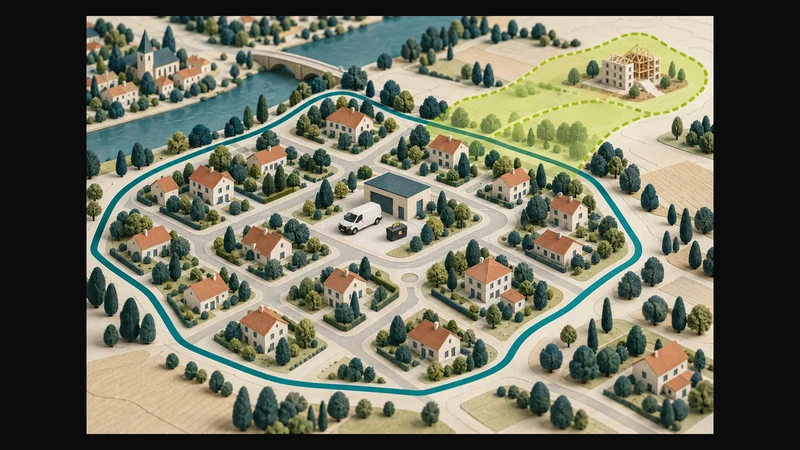
An electrician can serve several suburbs from one real base without presenting each suburb as a branch. The right local SEO approach is to distinguish where the business operates from, whether customers can visit and where the team will travel. Make those distinctions consistent across the website and Google Business Profile.
A service area describes where you work. It is not evidence of an office in every suburb, and it does not promise equal search visibility everywhere. Useful local content should answer a practical question: can this team take on this kind of job at my property?
Is your base a customer-facing shop or somewhere you dispatch from?
Start with what happens at the address, not what might look better on a map.
- You travel to customers and do not receive them at your base: represent the business as a service-area business.
- Customers visit a genuine shop or office during stated hours: assess it as a customer-facing location, including the signage and staffing requirements.
- Customers visit your premises and you also travel to them: a hybrid arrangement may fit, provided the location is staffed by your team and can receive customers during those hours.
Google’s guidelines for representing your business say a service-area business should have one profile for its central office or location and should hide its address from customers. Businesses displaying an address should maintain permanent fixed signage. A rented mailing address where the business does not operate is not eligible as a location.
A home office used for scheduling and storing equipment is not a shop simply because it has an address. For an electrician with one base, do not create extra profiles to target nearby suburbs. Use the genuine business name, without adding services or place names that are not part of it.
On the website, describe the base at an appropriate area level and explain that work takes place at customers’ properties. Do not invite walk-ins if nobody is there to receive them.
Set coverage by the work you can actually accept
Before changing public information, ask the person responsible for scheduling to separate coverage into three practical groups:
- Routine coverage: areas where you normally accept the advertised services.
- Conditional coverage: areas considered for particular work, such as planned installations, subject to scheduling and scope.
- Outside normal coverage: areas you do not actively serve and should not advertise as routine destinations.
These are recommended planning categories, not Google profile settings. Use them to decide what the website should say, then check the available profile controls in the account.
Coverage may differ by job type. The installation and repair lead guide applies the same distinction to paid advertising; this guide focuses on the website and Business Profile. A team might accept a planned installation farther from its base while limiting repair call-outs to a smaller area. If that is how the business works, say so beside the relevant service rather than hiding the distinction in a footer.
Avoid claiming to cover all of Gauteng if the team routinely declines enquiries from much of the province. Likewise, offering repairs does not automatically mean offering emergency or round-the-clock attendance. Advertise only the coverage and availability the team can support.
Google explains that local results depend mainly on relevance, distance and how well-known the business is. Accurate information helps explain the business, but listing another suburb does not remove distance as a factor. Coverage should describe where you can serve customers, not manufacture proximity.
Does each suburb need its own page?
Not necessarily. One clear coverage page linked to useful service pages may be enough.
Before creating a separate location page, ask:
- Can we genuinely accept the work this page advertises there?
- What would a customer learn that our existing service and coverage pages do not explain?
- Does availability differ by service, scheduling arrangement or property type?
- Do we have relevant, publishable work evidence from that area?
- Who will maintain the details when our operating arrangements change?
If only the suburb name would change, keep the information on the existing coverage page. A separate page makes sense when it resolves a distinct customer question with accurate information. A genuine project example can strengthen that explanation, but does not automatically justify another page.
Keep service-area wording separate from branch wording. “Electrical installation services in this area” describes where work is available. “Our office in this area” claims a physical presence. Use the latter only when it is true.
Illustrative example: one base, different coverage by service
Consider a fictional electrician operating from one non-customer-facing base in Pretoria East. The team accepts routine repair enquiries in selected nearby suburbs and considers planned installation projects farther away. It has no other branches.
A suitable website structure could include:
- Separate repair and installation pages, each explaining the work offered and its coverage conditions.
- One coverage page distinguishing routine areas from locations considered for planned projects.
- Genuine project summaries linked to the relevant service, with permission to publish customer material.
The repair page would name the areas normally served. The installation page could invite people outside that area to ask whether their project is within scope. The enquiry acknowledgement would explain that the team still needs to confirm location, scope and availability, rather than imply a booking.
Neither page would claim an office near every customer. A dedicated suburb page would be added only if it offered useful information beyond this structure.
Show relevant work without exposing customers
Evidence should support the service claim, not merely decorate the page.
For each publishable project example, record the broad area, property type, service supplied and what the team actually completed. Use original photographs where permission allows. A factual description of a lighting installation is more useful than an unsupported claim to be the area’s leading electrician.
Keep marketing evidence separate from technical instructions. Explain the work completed without telling readers how to carry out electrical work themselves. A project photograph also should not be presented as proof of qualifications or compliance.
Before publishing, check photographs for house numbers, faces, vehicle registrations, paperwork and security details. Obtain permission for customer material and use only the location detail needed to establish relevance. Do not use generated project photographs as evidence of completed work, or invent credentials to strengthen a page.
Reviews need the same discipline. Google’s Maps content policy prohibits incentives, selectively soliciting positive reviews and requests for specific review content. Ask genuine customers for honest feedback without asking them to include a suburb, service or staff member. Do not write the review for them.
Check whether a local visitor can make a suitable enquiry
Before adding more location content, work through this checklist:
- Identity: does the website use the same genuine business identity as the profile?
- Base: is it clear whether customers can visit, without exposing a non-public home address?
- Coverage: does each advertised service explain meaningful geographic limits?
- Availability: are hours accurate, without implying emergency cover you do not provide?
- Proof: do project descriptions match real work and approved photographs?
- Contact: do phone and enquiry routes reach the people handling these jobs?
- Initial information: does the form ask for a suburb, service type, brief description and contact details, rather than access codes, identity documents or financial records?
- Ownership: is someone responsible for confirming location, scope and scheduling fit before accepting the job?
The electrician’s website enquiry checklist explores the contact route in more detail. Once a suitable enquiry becomes a quotation, use the electrical installation quote follow-up guide to separate the next sales action from installation capacity.
After changes, record why enquiries are unsuitable: outside coverage, unavailable service, misunderstood hours or an assumed branch that does not exist. Use those reasons to identify the correction needed. For example, repeated out-of-area repair requests may call for clearer wording on the repair page, not more suburb pages.
Agree the facts before commissioning more pages
For each correction, record the affected page or profile, the confirmed business detail, the change required and who can approve it. This turns a vague request for better local visibility into specific work.
Digital 4 Jesus’s local SEO service covers alignment between business details, genuine operating areas, relevant pages and contact routes. Website access and profile access are separate considerations, so confirm who controls each before agreeing changes.
For a broader website plan, compare our SEO services with the local scope rather than assuming every visibility problem needs more suburb pages. Our Pretoria digital marketing agency explains how the real operating base connects to service coverage, campaigns and enquiry follow-up.
Bring your website address, current Business Profile, routine service areas and any differences between repair and installation coverage to the strategy enquiry form. Ask to discuss which profile details or pages need correcting before commissioning more suburb content.